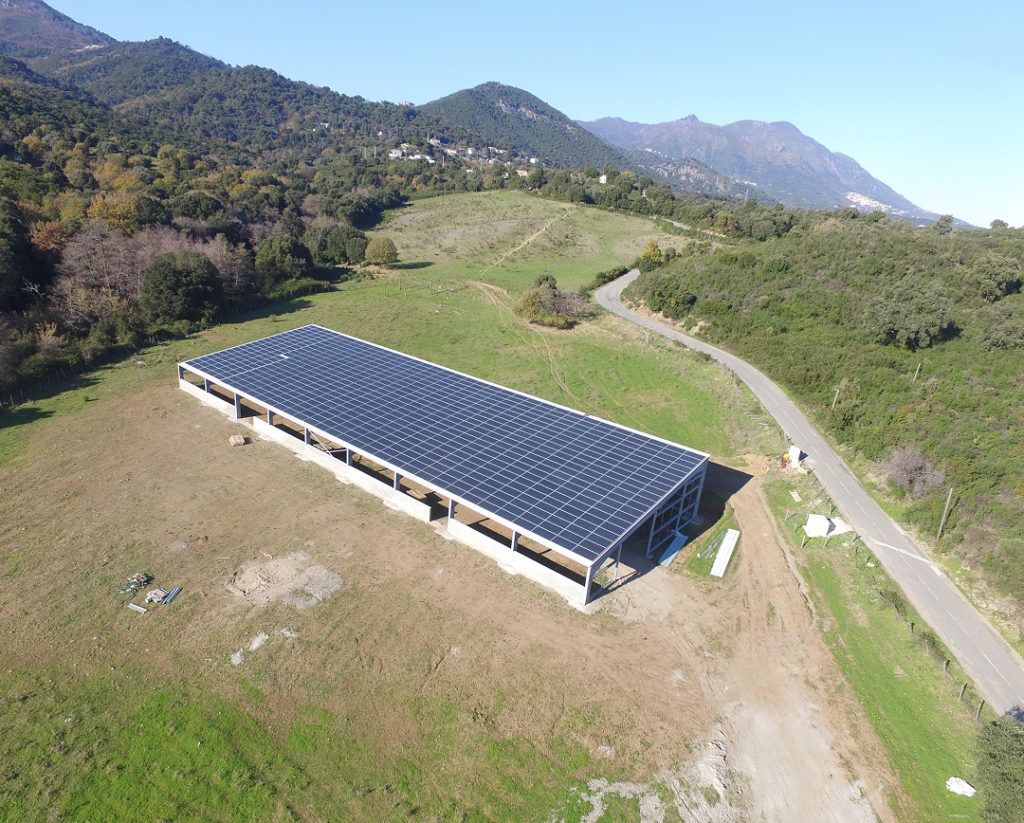
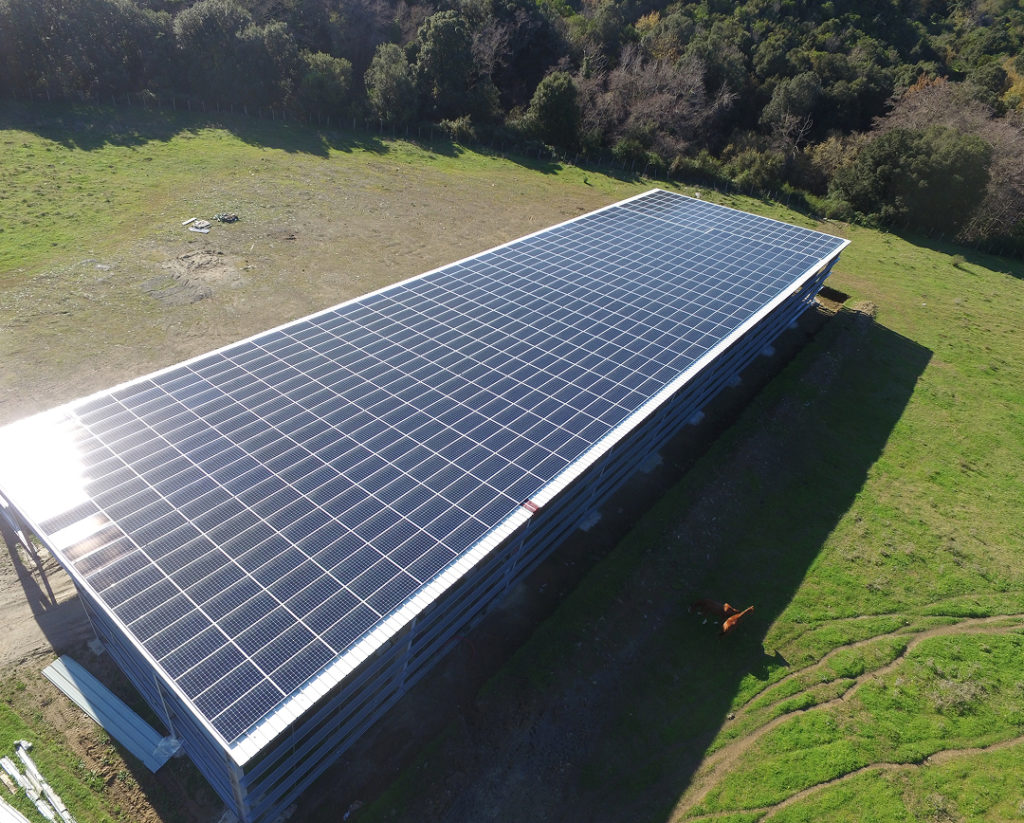
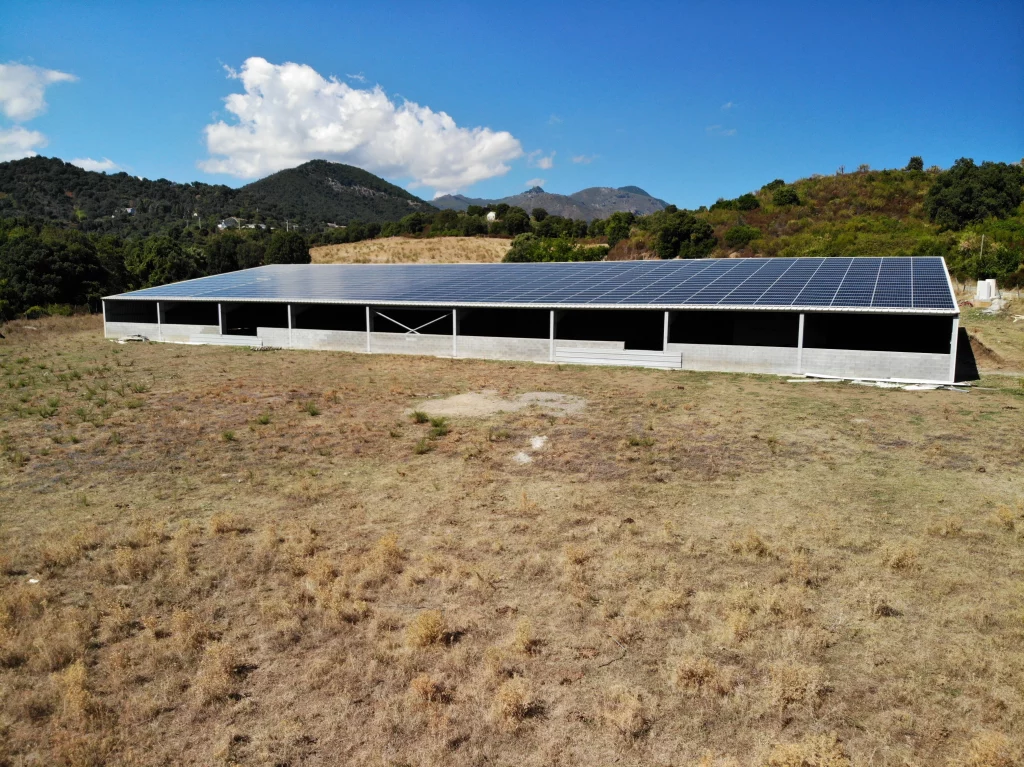
The Pinia solar rooftop installation in Corsica is installed on a 1,400 m² agricultural hangar. Developed in Ghisonaccia in partnership with SCEA Curellu, it was designed by Corsica Sole’s teams to meet both agricultural operational needs and energy requirements.
An agricultural hangar transformed into a green energy production facility
The installation comprises 570 solar panels, supplemented by 94 additional panels, for an initial installed capacity of 250 kWp, further increased by 36 kWp in order to optimise the full available roof surface.
This configuration maximises the use of every square metre of the hangar and significantly increases overall energy production.
Local and sustainable energy production
The Pinia solar rooftop generates 406 MWh of electricity per year. This renewable energy is injected locally into the grid, helping to reduce reliance on fossil fuels in Haute-Corse.
Relying on a simple, robust and optimised architectural design, the project illustrates how agricultural infrastructure can become a powerful lever for the energy transition, while fully maintaining its primary function in support of farming operations.
Energy storage: a resilience tool for the territory
The Pinia project also stands out through the integration of an energy storage system with a capacity of 0.6 MWh. This solution makes it possible to store part of the electricity produced during the day and release it in the evening or during peak demand periods.
This photovoltaic–storage combination strengthens the electrical autonomy of the farm and contributes to grid stability, particularly in an island context. According to Corsica Sole’s technical data, a hybrid power plant can cover up to 70% of an island territory’s daytime electricity needs, reducing reliance on fuel oil by more than 50% in certain non-interconnected areas.
A project serving agriculture and the territory
Beyond its technical aspects, the Pinia project is based on a successful cooperation model between an agricultural producer and a renewable energy specialist.
The establishment of easements has secured the construction, operation and maintenance of the power plant, while safeguarding the landowner’s property interests.
By generating a new source of financial revenue, the solar rooftop strengthens the economic vitality of the agricultural operation and demonstrates that farming activities and renewable energy production can coexist and reinforce one another.
An innovative rooftop for more sustainable agriculture
With this solar power plant coupled with energy storage, the Pinia rooftop becomes a genuine tool for local resilience and a strong example of sustainable diversification for the agricultural sector.
In Haute-Corse, this project contributes to building a more autonomous, cleaner and more resilient energy model, while supporting the stakeholders who shape the territory.
This 1,400 m² photovoltaic hangar is designed to combine renewable energy production with agricultural functionality. Its roof is fully equipped with solar panels. The integration of a battery storage system allows excess energy produced during the day to be stored and reused. Thanks to this system, we gain greater energy autonomy, reduce our dependence on the grid and actively contribute to the transition towards a more environmentally responsible and future-oriented model.
Did you know?
A hybrid solar-and-storage power plant can cover up to 70% of an island territory’s electricity needs during the day. Thanks to batteries, excess electricity produced by solar panels is stored and then released in the evening during peak consumption periods.
The result is a reduction of more than 50% in fuel oil use in certain non-interconnected zones, and several thousand tonnes of CO₂ emissions avoided every year.
Location
Ghisonaccia,
Haute-Corse (2B)
Key figures
Capacity
286 kWp
Annual energy production
406 MWh
Surface area
1,400 m²
Solar panels
664
*supplied with electricity (including heating)
227 peoples*