
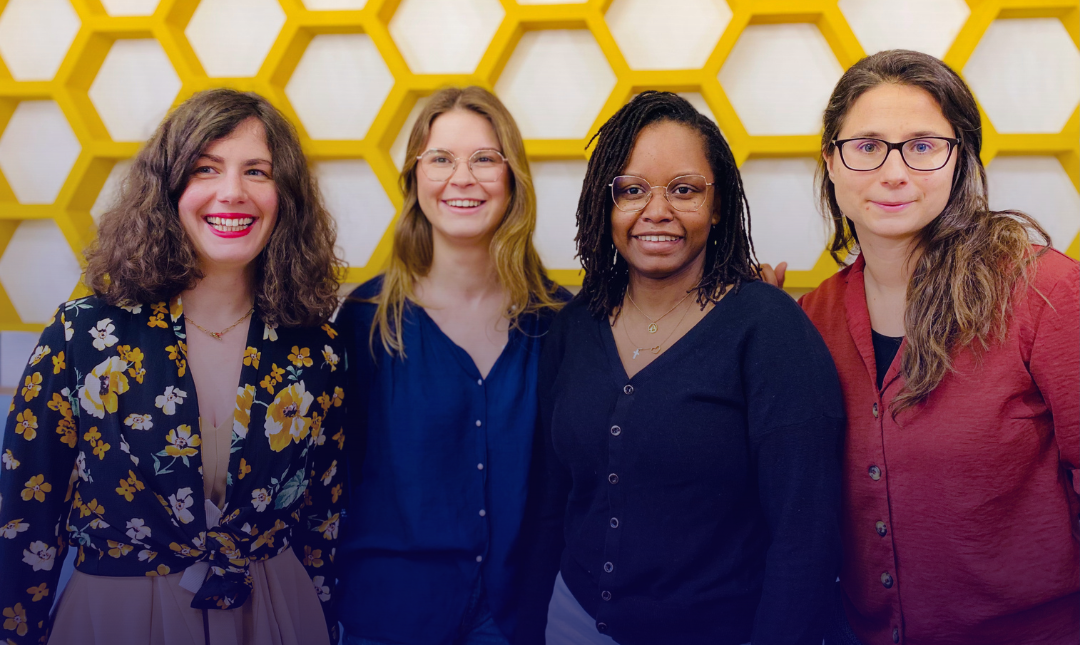
To mark International Women’s Day on 8 March 2024, Corsica Sole would like to highlight the careers of four female engineers.
Today, Corsica Sole is highlighting the essential role our female employees play in the energy transition. Their passion, determination and expertise enrich our team on a daily basis. Discover the careers of these ingenious female engineers who are shaping the future of renewable energy.
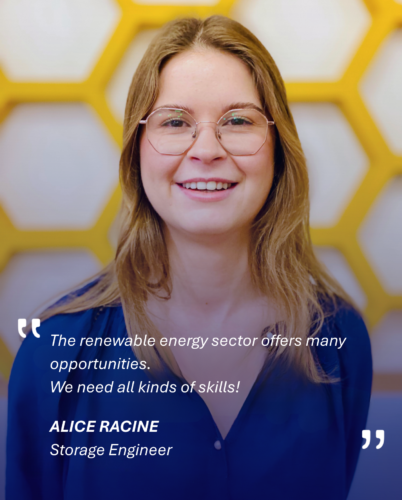
Alice, can you explain what your job involves?
Solar energy is intermittent, so Corsica Sole is dedicated to developing energy storage solutions aimed at stabilising the electricity grid.
My role within the company is to study how we can optimise the integration of storage into the electricity market in France. My responsibilities include market prospecting, regulatory monitoring, and liaising with network and distribution operators such as RTE and Enedis. I also perform calculations to determine the most advantageous battery model based on forecasts.
Women are still under-represented in the industrial and energy sectors. What prompted you to take the plunge?
As a teenager, I didn’t have a clear idea of what I wanted to do, but I knew I was passionate about physics and logic, so I opted for the science stream. Then, thanks to a careers advisor, I discovered engineering schools.
After secondary school, I enrolled in an engineering school and took general courses. It was the lecturers who passed on their passion for the energy and electricity sector to me. During my master’s degree, I specialised in automated electrical energy and systems. Eventually, I discovered the industry little by little, particularly through internships.
What advice would you give to young women who would like to join the energy sector?
Go for it! Don’t hesitate! It’s a dynamic sector that is undergoing a complete overhaul, with lots of opportunities to be seized! There are many sub-fields, and just because it’s industry and energy doesn’t mean it’s necessarily very technical. The renewable energy sector needs all kinds of skills.
Working in the renewable energy sector is very rewarding. When you take a step back, you’re talking about the climate, and it’s nice to know that you’re having a positive impact on society and the environment.
To answer your question, you shouldn’t be afraid of being surrounded by boys. When you’re working, you don’t even notice the difference. The main thing is to find your place, a job that interests you and that adds value for you and society.
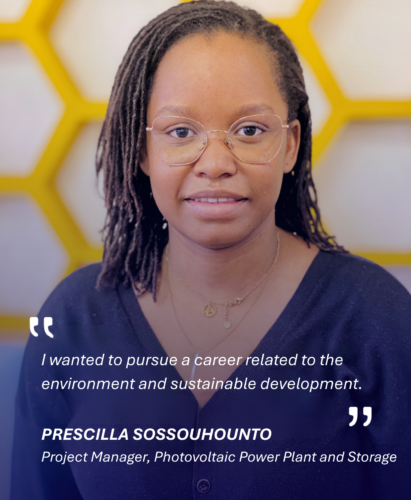
Prescilla, can you explain what your job involves?
As project manager, my job is to bring the project to fruition once the authorisations have been obtained. This involves setting up a monitoring system, coordinating the various people involved and determining when their intervention is necessary. My role also includes gathering all the information needed to carry out the project.
In short, it’s a bit like building a house. It’s about defining how it’s built, surrounding yourself with the right people, finding the necessary financial resources and making sure everything runs smoothly.
Women are still under-represented in the industrial and energy sectors. What motivated you to take the plunge?
I loved science and physics. For my studies, I took a science course in secondary school, then attended a general engineering school with a specialisation in energy and the environment. At the same time, I enrolled in a master’s degree in sustainable development to further my knowledge.
Having grown up in Benin, the problems of power cuts and pollution really made me aware of climate change. So I decided to combine science and physics with sustainable development and turn to renewable energy. It was an obvious decision for me.
What advice would you give to young women who want to join the energy sector?
You have to define what you want to do professionally and not be afraid. Don’t be afraid to find yourself in a male-dominated environment.
Things have changed a lot, so don’t worry, it’s fine. A different perspective can bring a lot to the table and complement the team well. Personally, it’s never been a problem for me. My teachers at secondary school advised me to study biology, but I said no. I knew what I wanted.
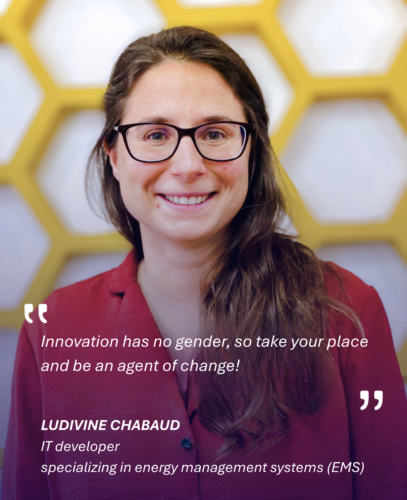
Can you explain what your job involves?
I focus on optimising energy management and injection into the grid. My job is to develop and refine Python algorithms designed to optimise the performance of the EMS (Energy Management System) in power stations. These algorithms are thoroughly analysed and tested in scenarios that we try to make as realistic as possible. I’m also responsible for IT maintenance in Bastia.
Women are still under-represented in the industrial and energy sectors. What prompted you to take the plunge?
I have always been passionate about science and technological innovation. In terms of my academic background, I studied science at secondary school, then did a bachelor’s degree in biology, a master’s degree in environmental science, and finally a PhD in geoscience.One day, I realised that I really wanted to get into programming! No one steers you towards these fields when you’re a girl, even though, during my biology studies, I systematically chose all my options and specialisations in computer science!Once the COVID-19 period was over, I decided to train in programming with the CodeFirstGirls association. This association offers free computer programming training courses taught by professionals, and it really changed everything for me. In fact, it was my passion for programming and my desire to contribute to the world that led me to photovoltaics.
What advice would you give to young women who would like to join the energy sector?
Ladies, remember that your career path and choices should be focused primarily on your personal fulfilment and financial independence.
Embarking on a career in fields such as engineering or programming in the energy sector can not only offer you a rewarding and stable career, but also boost your self-confidence and personal pride.If certain terms or concepts seem intimidating when reading training descriptions, job titles or even this article, know that this is a feeling shared by everyone at the beginning.The important thing is to get started and progress step by step. Innovation has no gender, so take your place and be an agent of change!
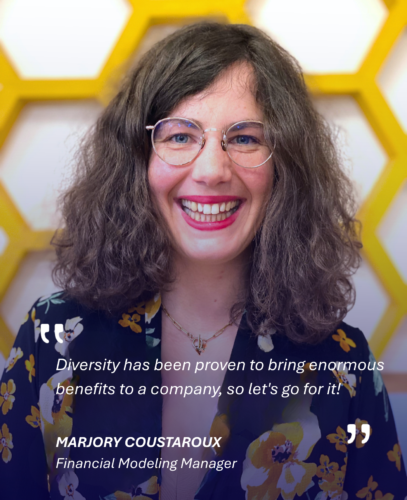
Can you explain what your job involves?
I develop modelling tools, mainly in Excel, i.e. business plans for all the projects we develop and build at Corsica Sole. I then monitor the financial performance of the projects in operation. The tools I develop help to optimise certain internal processes. The second part of my responsibilities involves implementing project optimisation models, which enable decisions to be made about the feasibility or abandonment of a project.
Women are still under-represented in the industry and energy sector. What prompted you to take the plunge?
I’ve loved mathematics since I was a child. After studying mathematics at engineering school, business school and five years in corporate finance, I wanted to give my career a little more meaning, which is why I decided to turn to renewable energy and photovoltaics.
I never really said to myself, ‘I can’t do this because I’m a woman,’ so I went for it and the question never even arose. I never put up any barriers for myself.
What advice would you give to young women who want to join the energy sector?
Go for it! We are all different and capable of contributing something! Diversity has been proven to bring enormous benefits to a company.
When you’ve studied, you’re lucky enough to be able to choose, so go for it! Go to interviews, don’t get discouraged, don’t put up barriers! You have to try, and if it doesn’t work out, it doesn’t matter, you can try something else. There are no failures, only experiences that allow us to learn.